

How Does Brain Register Taste
Abstract
The power to taste brings u.s.a. some of the finest things in life: the sweetness of candy, the saltiness of fries, and the sourness of lemonade. We all know it starts on the tongue, merely how does it really work? Scientists have discovered that taste comes from a chain reaction that starts with sensitive proteins on your natural language, races through taste buds, enters your nerves, and ends in your brain. 1 of the most amazing findings is that gustatory modality sensitivity varies from person to person. Each of usa lives in a unique taste earth, making everyone different in the foods they love and detest.
Introduction
Call up of your favorite food. Is it pizza? Chocolate? Sushi? Imagine your favorite treat and the pleasure you become from eating it. What almost a food you dislike? Foods take many different properties that contribute to enjoyment: smell, temperature, and even how they feel in your oral cavity. Ane of the about important backdrop of nutrient is taste, the combination of sweet, sour, salty, biting, and savory sensations coming from your tongue. How are these signals conveyed from the mouth to the encephalon? This has long been a mystery. However, scientists looking closely have uncovered remarkable details about the pieces making upward the taste system, and how these pieces fit together [one].
A Closer Look at Your Natural language
What do nosotros see when we stick out our tongues? Bumps. Lots of bumps. Well-nigh people think they are sense of taste buds, simply it is a petty more complicated than that (Figure 1). The bumps we encounter are chosen papillae , and they are a special tough function of our skin. The real taste buds are made up of delicate cells nestled like sections of an orange below the surface of the papillae, where they are well protected. Simply the tips of the sense of taste buds poke through to the surface of the tongue. The gustation buds cannot be seen with the naked heart, but if yous could zoom in, you would see that each of our papillae contains thousands of taste buds, all peeking out [2].
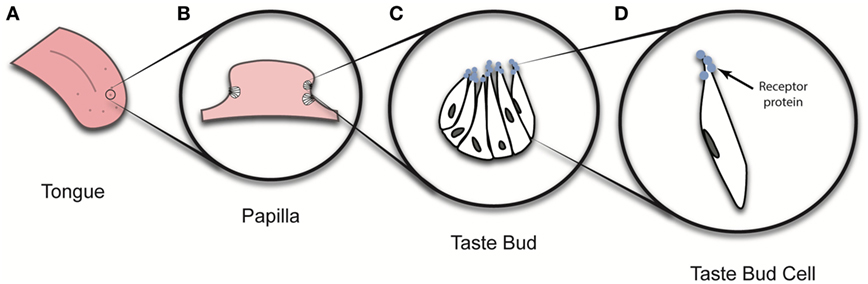
- Figure one - The construction of the natural language.
- A. The bumps on the surface of the natural language are called papillae. B. Taste buds are subconscious beneath the surface of the papillae and barely poke out. C. Each taste bud is made up of a cluster of cells, which are packed together similar segments of an orange. D. The cells making upwards taste buds store special taste receptor proteins at their tips, which respond to particles in nutrient. Each taste bud cell is attached to nerves at its base, as shown in Figure 2.
Gustatory modality Detectors
At their very tips, where they poke out from the natural language, each gustatory modality bud jail cell stores tiny proteins chosen gustation receptors (Figure 1) [3]. Thousands of different proteins are establish in our bodies, and each plays a special function in the body'southward structure and role. The office of gustatory modality receptor proteins is to observe substances in your oral cavity, such every bit food particles. There are five specialized kinds of taste receptor proteins, and each kind detects particles with one of five basic tastes: sweet, sour, salty, bitter, and savory (the "meaty" aspect of foods such as soup broth). Taste receptors actuate when chewed food mixes with saliva, so flows over and effectually the papillae like a mushy river. The receptor proteins ignore most of the mix, but when they find their target nutrient particles they react, notifying their cells that a taste substance has been detected. This process can be imagined equally if the receptors are locks and the nutrient particles are keys. Only as a lock opens only with its matching key, a gustatory modality receptor reacts only to its matching blazon of food particle.
Sending a Bespeak
When a taste bud cell is notified that a substance such equally nutrient has been detected, it goes into action (Figure 2). The gustatory modality bud puts dozens of proteins inside the cell to work. These proteins cooperate, rapidly shifting electrically charged atoms called ions here and there, to produce a tiny electrical electric current inside the cell [2]. This impulse is so tiny y'all cannot feel it. All the same, information technology is detected by the nerves in your tongue, which are specialists at detecting and passing on electrical signals. When the nerves in your natural language receive signals from taste bud cells, they pass them on to more fretfulness and and so more, sending the message racing out the back of your mouth, upwards through a tiny hole in your skull, and into your brain. There, your gustatory cortex (the taste center of your brain) finishes the job of telling you, which gustatory modality you perceive, sweet, salty, bitter, sour, or savory.
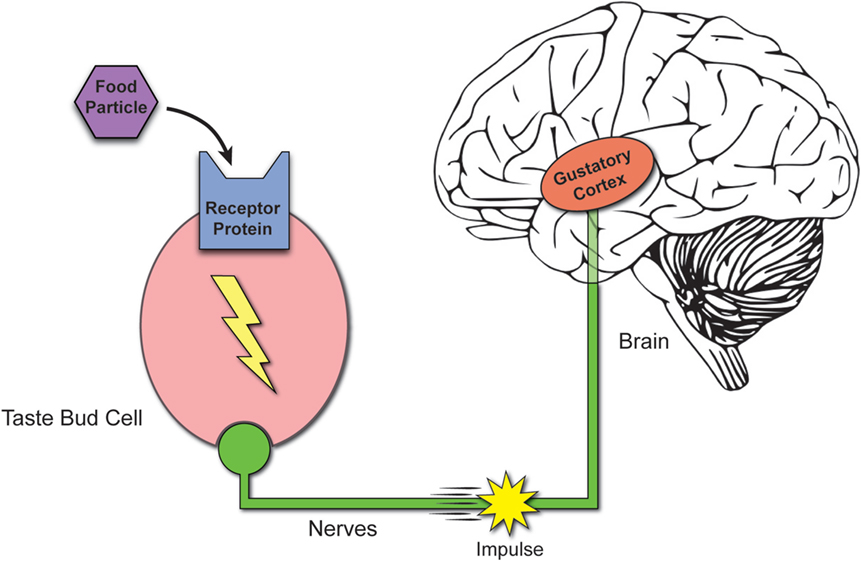
- Figure 2 - Gustation signals.
- Taste signals begin when nutrient particles are sensed by receptor proteins on the gustation bud cells. When the receptor proteins sense different kinds of particles, they order their taste bud cell to send a modest current to the nervous system, which relays the impulse to the encephalon. This diagram is simplified and shows a gustatory modality bud cell with one receptor protein. In reality, each gustatory modality bud jail cell has millions of receptor proteins.
Differences in Sense of Taste
The basic sense of taste system is the same for all of us. Fifty-fifty toddlers pucker their faces at sour lemons, smile when tasting sweet things, and dislike bitterness. However, people practise differ from each other in of import ways. You have probably noticed that some of us are more sensitive to tastes than others. For instance, vegetables in the Brussels sprouts family incorporate a substance called goitrin that is strongly bitter and icky to some people, but other people can barely gustation it. Why is this? One reason is that different people have different numbers of taste buds [i]. Each taste bud cell adds a little bit to the strength of a gustatory modality, then people with more taste buds are more sensitive. This holds truthful for all tastes, not just bitter. Scientists fifty-fifty take names for people with different sensitivity levels. People with the lowest overall sensitivity are called "not-tasters." Those in the heart are called "medium tasters." Those with the greatest sensitivity are called "super tasters." Which do you recollect you lot are? What about your friends?
Be a Gustation Researcher
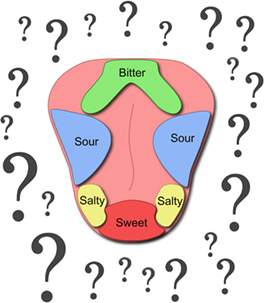
Researchers around the world investigate the process of sense of taste considering taste affects what people eat, and what people eat affects their wellness [1]. At that place is even some taste research you tin do in your own kitchen. One theory yous tin can investigate is that gustatory modality sensitivity is laid out like a map on your tongue. For many, many years, books have taught the states that salty and sweet tastes are sensed at the tip of the natural language, while bitter is sensed at the back and sour at the sides (Box 1, effigy). The heart of the tongue, which has few taste buds, is often left blank. However, taste researchers now believe that taste sensitivity does not follow a unproblematic map. They say tastes can be perceived everywhere on the natural language. Try testing yourself using the experiment in the Practise-it-Yourself (Box one). How well does gustatory modality sensitivity on your own natural language fit the map?
Box 1. Do-it-Yourself: Testing the Tongue Map
Many books and magazines say taste sensitivity follows a map on your tongue: the front is for salty and sweet, the dorsum is for bitter, and sour is at the sides (effigy). (Savory, which is a more recent discovery, is commonly left out.) This experiment will test the sensitivity of different regions of your tongue to sweet, sour, and salty tastes, so y'all can compare your ain patterns with the map.
Supplies
-
Lemon juice.
-
Table salt.
-
Sugar.
-
Iii small glasses of water.
-
Tablespoon.
-
Q-Tips.
Procedures
-
Wash your easily.
-
Set taste testing solutions:
-
Add a tablespoon of lemon juice to the outset glass of water.
-
Add a tablespoon of common salt to the second glass.
-
Add a tablespoon of saccharide to the third glass.
-
Stir each glass well, rinsing the spoon between solutions. It is fine if the sugar and salt don't dissolve.
-
-
Dip a Q-Tip in the salt solution and dab it on the back of your tongue. Write down what you taste. Repeat for the sides, center, and front of your tongue. Attempt other locations on the tongue, as well.
-
Attempt the test using the sweet and salty solutions. Make sure to use unlike Q-Tips.
Results
Which regions of your tongue can sense each gustation? Do they match the gustation map? Endeavor the experiment with your friends. Do they have the same patterns of sensitivity you exercise?
Glossary
Papillae: ↑ Bumps of tough skin on the surface of the natural language. They protect sense of taste buds within them.
Taste Bud: ↑ Package of cells specialized to find taste.
Sense of taste Receptor: ↑ Tiny protein found on the tips of gustation buds, which responds to particles of food.
Disharmonize of Interest Statement
The authors declare that the enquiry was conducted in the absence of whatever commercial or financial relationships that could be construed as a potential conflict of interest.
References
[one] ↑ Bradbury, J. 2004. Taste perception: cracking the lawmaking. PLoS Biol. 2(3):E64. doi:10.1371/journal.pbio.0020064
[2] ↑ Smith, D. Five., and Margolskee, R. F. 2001. Making gustatory modality. Sci. Am. 284:32–9. doi:10.1038/scientificamerican0301-32
[3] ↑ Chaudhari, Due north., and Roper, S. D. 2010. The jail cell biological science of gustatory modality. J. Cell. Biol. 190:285–96. doi:ten.1083/jcb.201003144

How Does Brain Register Taste,
Source: https://kids.frontiersin.org/articles/10.3389/frym.2017.00033
Posted by: healeysaings.blogspot.com
0 Response to "How Does Brain Register Taste"
Post a Comment